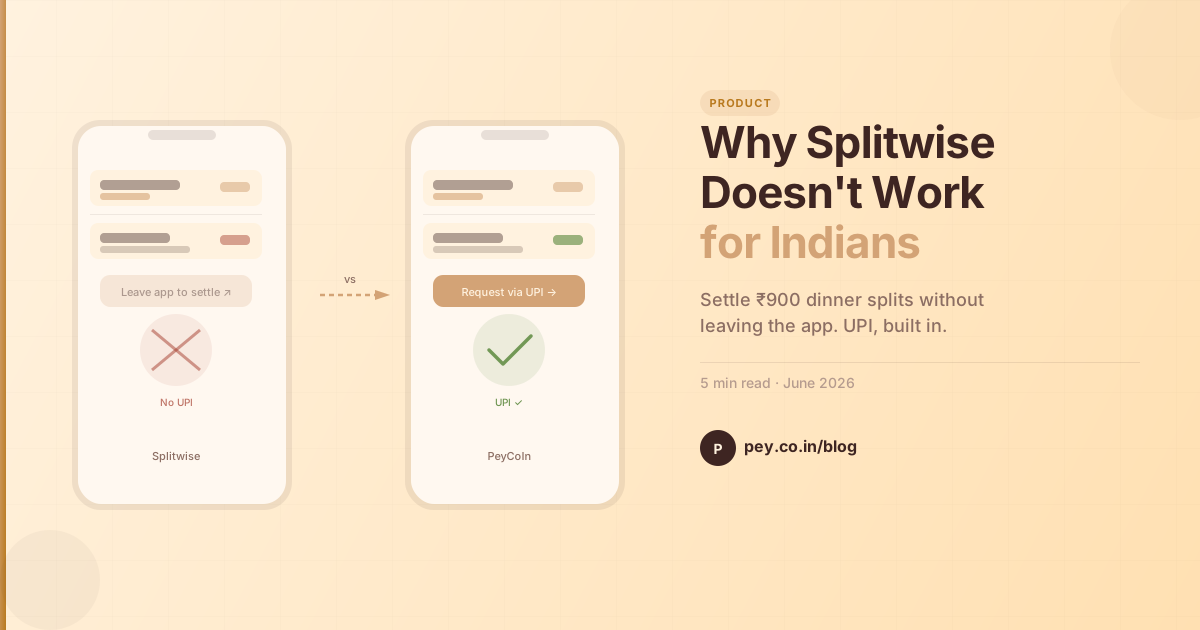
Here's a scenario that happens every day: you're splitting dinner with three friends. The bill is ₹3,600. Splitwise calculates it perfectly — ₹900 each. You open Splitwise, add the expense, split it equally.
Splitwise knows you owe ₹900.
But here's what Splitwise doesn't know: you set a ₹3,000 food budget for the month, and you've already spent ₹2,800.
That dinner doesn't just cost you ₹900. It puts you ₹700 over budget. The rest of the month is going to be uncomfortable.
Splitwise logged the expense. It had no idea about the consequence.
What "budget-blind" means
A budget-blind app can tell you how much you spent. It cannot tell you whether you could afford to spend it.
Splitwise is budget-blind by design. It was built to solve one problem: "Who owes whom in a group?" It does that brilliantly. Your personal financial situation is outside its scope.
Personal finance apps have the opposite problem: they're group-blind. YNAB, Goodbudget, and Mint track your personal spending beautifully — but when you split a ₹2,000 grocery bill, they record ₹2,000 spent. They don't know ₹1,000 is coming back from your roommate. Your budget breaks.
Both halves of your financial life are invisible to the other.
The real cost of budget-blindness
Overspending in groups. When you can't see your budget while splitting, you default to saying yes. The "I'll figure it out later" reflex costs you ₹2,000-₹5,000 a month in micro-overruns across dinners, trips, and convenience purchases.
Budget math that doesn't add up. You track everything in your personal app, hit the end of the month, and the numbers don't match your bank. The discrepancy? Shared expenses that were logged at full cost, not your share.
Decision friction. Every group expense decision involves a mental calculation across two apps — or an uncomfortable guess. This friction causes people to either overspend (say yes to avoid awkwardness) or under-participate (say no to avoid spending).
How PeyCoIn solves budget-blindness
PeyCoIn has both the personal budget layer and the group expense layer in the same app. They talk to each other.
When you add an expense to a group:
- Your share (not the full amount) is reflected in your personal spending
- Your budget dashboard updates to show the impact
- Your 7-day trend adjusts accordingly
When someone asks "should we split this?", you can answer from a real number, not a guess.
The personal budget side shows:
- Your monthly budget per category (food, transport, entertainment, etc.)
- How much you've spent so far this month
- Your 7-day trend (are you on pace or running hot?)
- A streak counter for consecutive on-budget months
The group side shows:
- All expenses per group
- Running balances per person
- Your net position across all groups
- UPI settlement — pay directly from PeyCoIn if the recipient has added their UPI ID
Same app. Both sides visible. No blindness.
A concrete example
You have a ₹3,000 food budget. You've spent ₹2,400 so far this month (your share of group meals + personal lunches). A friend texts: "dinner tonight, Italian, splitting 6 ways, should be ₹800 each?"
Old world: guess (your instinct says you're probably fine). Log it in Splitwise. Check your budget app later. Discover you're ₹200 over.
PeyCoIn world: open the app. See ₹600 left in your food budget. Know instantly: ₹800 is $200 over. You can either skip, suggest a cheaper place, or accept the overspend consciously.
The decision is the same. The information is different. Better information means fewer regrets.
Why no one built this before
Personal finance apps (YNAB, Mint, Goodbudget) are built around you as an individual accounting unit. Group expenses are an edge case for them.
Group expense apps (Splitwise, Tricount, SettleUp) are built around the group. Your personal finances are invisible.
Nobody built both because they're genuinely different problems — different data models, different UX patterns, different mental models for users.
We built both because we had to. The blind spots were costing us money personally before we decided to fix them with PeyCoIn.
About PeyCoIn
PeyCoIn is a free app that combines personal budget tracking and group expense splitting — with UPI-connected settlement, offline-ready access, and zero data sales. Built in India, for India and the world.