Most people don't think about what happens to their data. You log a dinner with friends. You track your rent split. You record that Uber to the airport. It feels like private information — just between you and your app.
But is it?
What most free expense apps do
Most free consumer apps follow the same pattern: the product is free because the business model lives elsewhere — ads, analytics, data partnerships, or a premium tier. Expense apps are no exception.
Common practices across the category (which you can verify by reading any app's privacy policy):
- Third-party analytics. Usage data and behaviour patterns are typically shared with analytics providers to improve the service. This is standard across the industry.
- Advertising. Free tiers in many apps are ad-supported. To show contextually relevant ads, apps often use in-app behaviour as a signal.
- Aggregated or anonymized sharing. Many apps reserve the right to share aggregated or anonymized data with third parties for research or partnerships.
- Cloud retention. Your transaction history lives on the provider's servers for as long as you have an account, under their data retention policy.
None of this is sinister — it's the standard trade-off for a free product. You should read the privacy policy of any app you use with financial data, and decide if the trade-off works for you.
Why expense data is sensitive
Your expense history reveals more than you think. It shows:
- Where you go (restaurants, bars, gyms, clinics)
- Who you spend time with (names of friends and roommates)
- How much money you have (bill sizes, frequency of going out)
- Your relationship status (split with one person repeatedly? That's a signal)
- Your health habits (regular pharmacy purchases? Meal delivery?)
- Your lifestyle phase (student budgets vs. early career vs. family expenses)
Insurance companies, lenders, and advertisers have historically paid for data like this. Your spending patterns are a valuable profile.
What PeyCoIn does differently
We made a deliberate choice early on: don't build a business model that depends on your data.
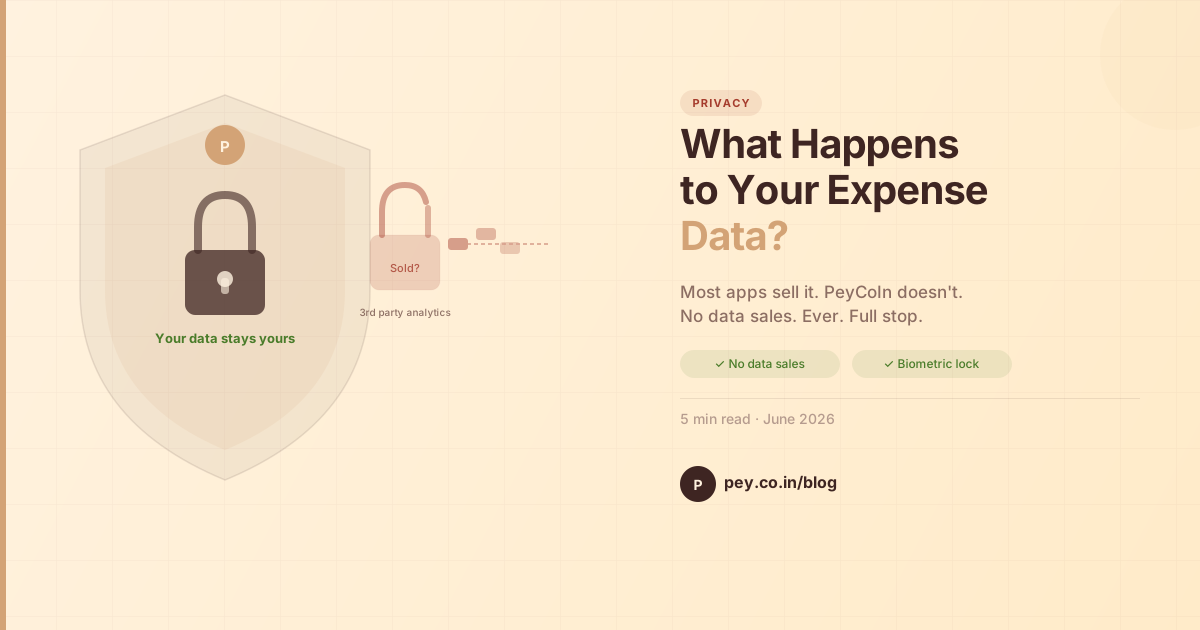
- No data sales. Ever. Not anonymized, not aggregated, not "for research." Your transaction data is not our product.
- Offline-ready privacy. Your data lives on your phone first. You can add and review expenses even when connectivity is patchy, with sync happening only when needed.
- Biometric security. Face ID, fingerprint, or PIN. The app doesn't open without you. Your data is locked even if someone has your unlocked phone.
- Transparent privacy policy. Ours is written in plain English, not legal jargon. We tell you exactly what we collect, why, and what we don't do.
- One quiet ad. We make money from a single, non-intrusive banner ad in your expense feed. Never a popup. Never full-screen. You pay with a glance, not your data.
The honest trade-off
We're not criticising any specific app. Every free product makes trade-offs; the model is disclosed in the privacy policy. The trade-off we're describing is industry-wide: a free app that funds itself through data or analytics, vs. a free app with a quiet banner ad and no data sales.
Most people don't care about this today. You might not care. That's fine.
But here's what we believe: privacy is becoming table stakes. After data breaches, targeted ads that feel eerily accurate, and growing awareness of how consumer data is used — more people are paying attention.
When you care about privacy, you'll want to have been with PeyCoIn from the start — not scramble to switch after your spending history has already been profiled.
What you can do right now
If privacy matters to you: download PeyCoIn, try it alongside Splitwise, and see if the approach fits your life. You don't have to delete Splitwise tomorrow. Just try having an option that doesn't sell your data.
If privacy doesn't matter to you right now: that's completely valid. Use what works.
Either way — knowing what happens to your data is better than not knowing. Now you know.
About PeyCoIn
PeyCoIn is a free app that combines personal budget tracking and group expense splitting — with UPI-connected settlement, offline-ready access, and zero data sales. Built in India, for India and the world.