You're sitting at dinner with friends. The bill comes to $87.50. You and three others are splitting equally, so that's $21.88 each. You pull out your phone, open Splitwise, log the expense, and mark who was there.
Splitwise does the math: you owe $21.88.
But here's the quiet question nobody asks: Can you afford it?
You're on a $2,000 monthly food budget. You've already spent $1,800. That $21.88 dinner puts you $120 over budget — and you haven't eaten for the next 8 days.
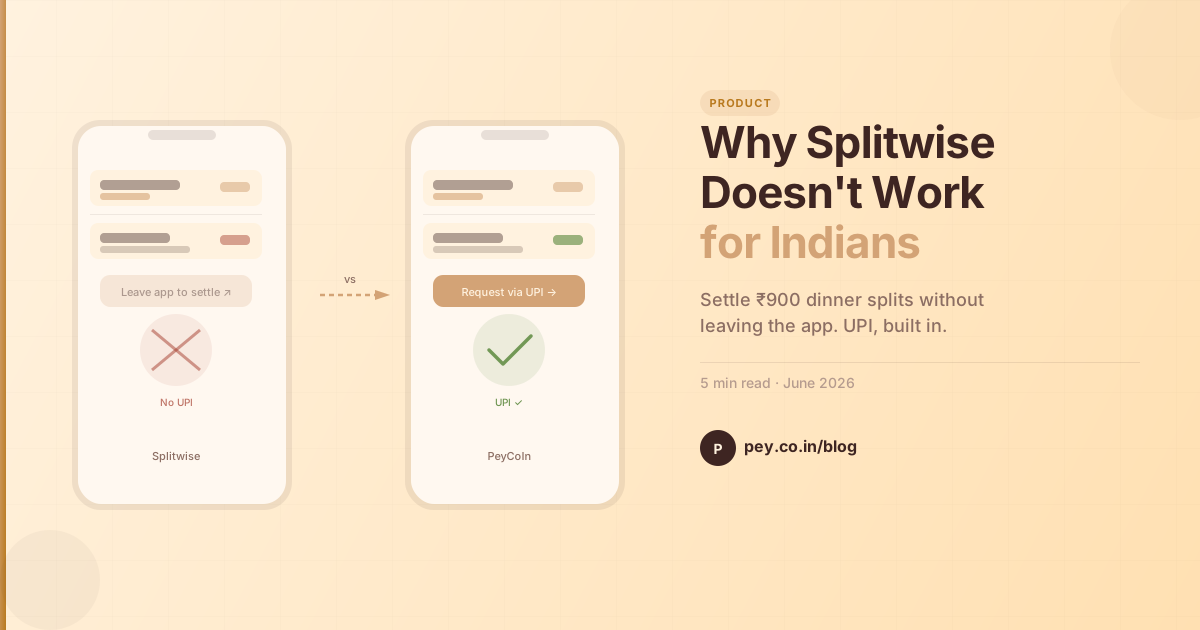
Splitwise has no idea. It only knows one thing: who owes what. Your personal finances? A blind spot.
The Splitwise trap
Splitwise launched in 2011. It's genuinely useful. It solved a real problem: "How do I track what my roommates owe me?"
Over 14 years, millions of people adopted it. Your friends probably have it. It works.
But it only solves half the problem.
Here's what Splitwise does:
- Track group bills (rent, groceries, Ubers, dinners)
- Calculate running balances ("James owes you ₹470")
- Remind you to settle up
Here's what it doesn't do:
- Tell you if you can afford to split that bill
- Track your personal spending separate from shared costs
- Help you stay on budget while managing shared expenses
- Show you the complete picture of your money
So what do most people do? They use two apps.
Splitwise for group tracking. A separate app (YNAB, Goodbudget, Mint, or a spreadsheet) for personal budgeting. Two apps. Two inboxes. Two data silos. Twice the friction.
The personal finance blind spot
Personal finance apps have their own problem: shared expenses don't calculate correctly.
If you split a ₹2,000 grocery bill with your roommate, YNAB shows ₹2,000 spent. Your budget is now ₹2,000 over — even though you only actually paid ₹1,000.
The app doesn't know that a friend is paying you back ₹1,000. It counts the full amount. Result: your budget math breaks. You think you're overspending when you're actually on track.
Why this matters (more than you think)
Context switching. You're out to dinner. Friends suggest splitting a fancy starter. You need to check: "Can I afford this?" (requires opening personal finance app) and "Who's paying?" (requires Splitwise context). By the time you've thought through it, the moment's passed.
Data silos. Your personal app doesn't know about shared expenses. Your expense app doesn't know about your budget. You're managing two separate realities that, in real life, are deeply connected.
Overspending. When people can't see their complete financial picture, they overspend. You think you have ₹2,000 left to spend. What you don't see: your friend group is about to split a ₹3,000 hotel bill next week.
What if one app handled both?
That's the premise of PeyCoIn.
Personal side: Log your own expenses (coffee, gym, rent, entertainment). Assign to categories. Set a monthly budget. See your 7-day spending trend. Streak counter (how many months in a row have you stayed on budget?).
Group side: Create a group (roommates, friend trip, family). Add an expense. Mark who was there. Choose split type. See running balances instantly.
Friends side: See your net balance with every person. Across all groups and all currencies. One place to see: "Who do I owe? Who owes me?"
The result? You see your real financial position: how much you've spent personally, how much you have left, how much your friends owe you.
The things nobody talks about
Offline access matters. You're on a trip to Goa. No WiFi. You eat dinner, split the bill, and log it into PeyCoIn. The app keeps working when the network doesn't. Other apps often pause until you're back online.
Privacy is real. Your spending habits are intimate. Most free expense apps are ad-supported or analytics-driven — your spending patterns fund the product. PeyCoIn: no data sales, ever.
Ten languages, including right-to-left. Most apps are English-only. We support 10 languages because we're built for the world.
Who this is for
PeyCoIn is for you if: you share money with friends or roommates, you also want to track your personal spending, you care about privacy, you travel internationally, or you value apps that work offline.
PeyCoIn is not for you if: you only need pure group expense tracking (Splitwise is great for that), or you never budget personally.
One app. Complete picture. That's the bet we're making.
About PeyCoIn
PeyCoIn is a free app that combines personal budget tracking and group expense splitting — with UPI-connected settlement, offline-ready access, and zero data sales. Built in India, for India and the world.